“We were very excited and thirsty for those connections again. Not having it made clear it’s a necessity.”
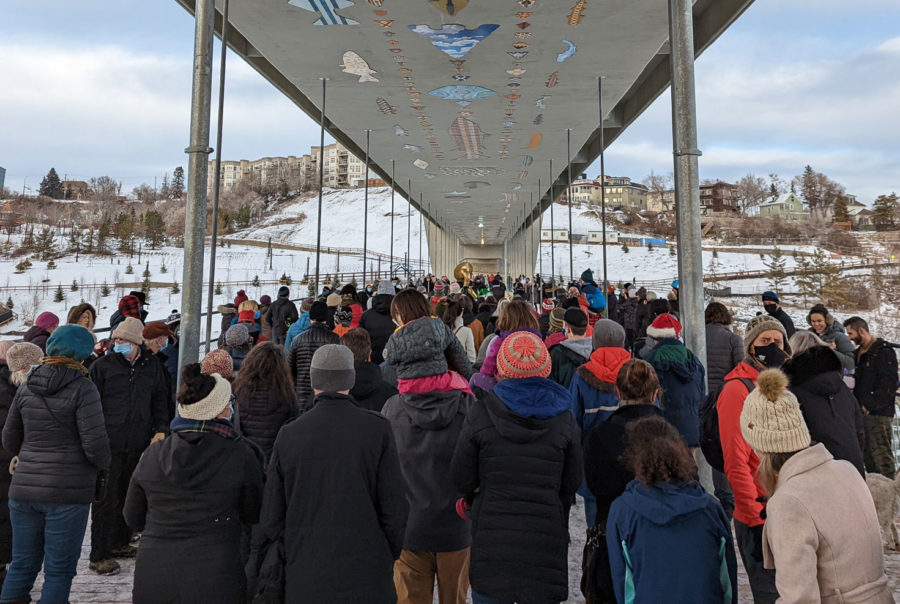
Community celebration on the day of the Tawatinâ Bridge opening to pedestrian and bicycle traffic, December 12, 2021. (Image courtesy of the City of Edmonton)
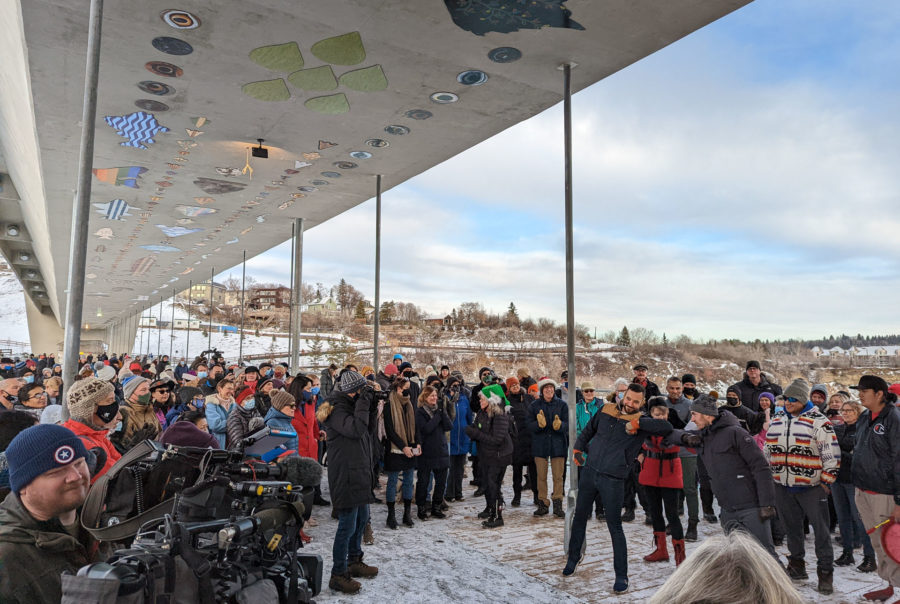
On December 12, 2021, residents of Riverdale and Cloverdale crossed the North Saskatchewan River on the newly opened Tawatinâ Bridge. (Image courtesy of the City of Edmonton)
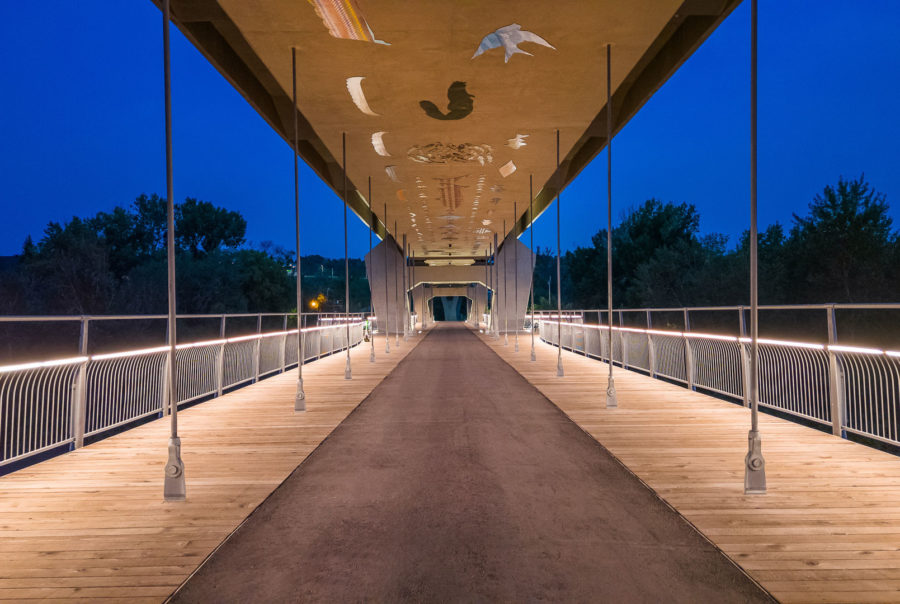
The lower deck of the Tawatinâ Bridge is open to people walking, biking, rolling and enjoying art—the ceiling features artwork by Indigenous artist David Garneau. June 2023. (Image by Scott Bruck, courtesy of the City of Edmonton)
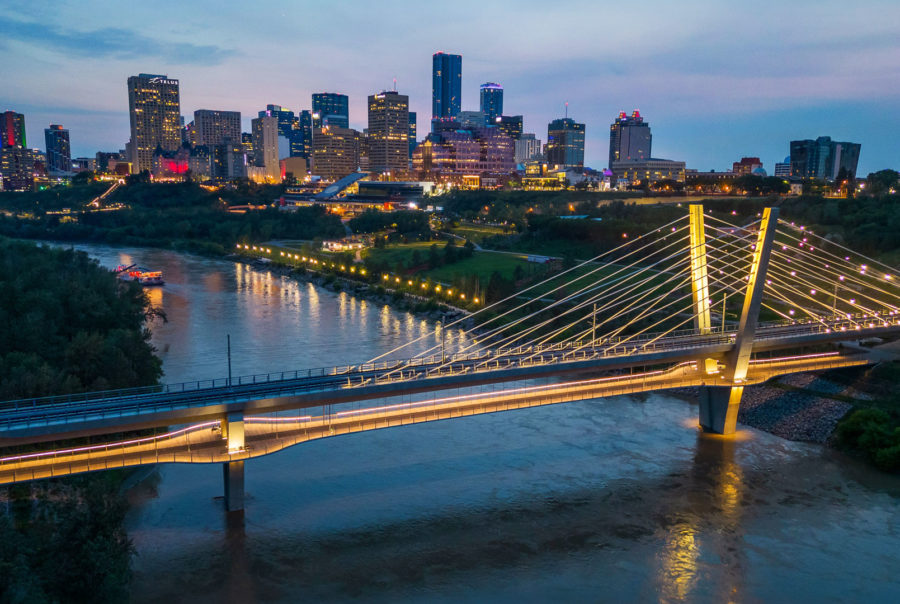
The Tawatinâ Bridge is 260 metres long and crosses the North Saskatchewan River just east of the Edmonton Convention Centre. The main deck carries the LRT, while the lower deck is open to people walking, biking, rolling and enjoying art. June 2023. (Image by Scott Bruck, courtesy of the City of Edmonton)
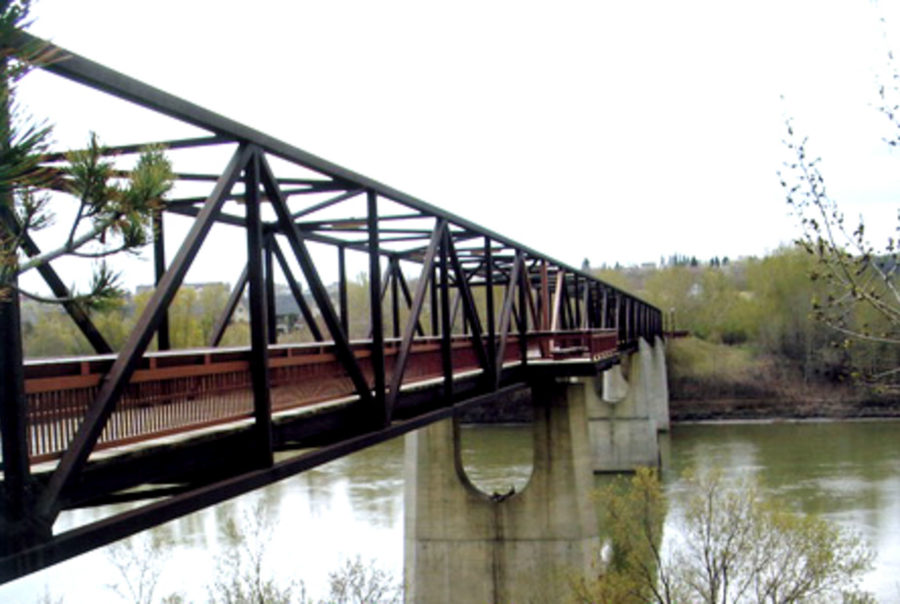
Cloverdale footbridge served as a connection between Riverdale on the north and Cloverdale on the south from 1977 to 2016. Pictured here in 2005 from the north bank looking south. (Image courtesy of City of Edmonton Archives, EA-596-1826)
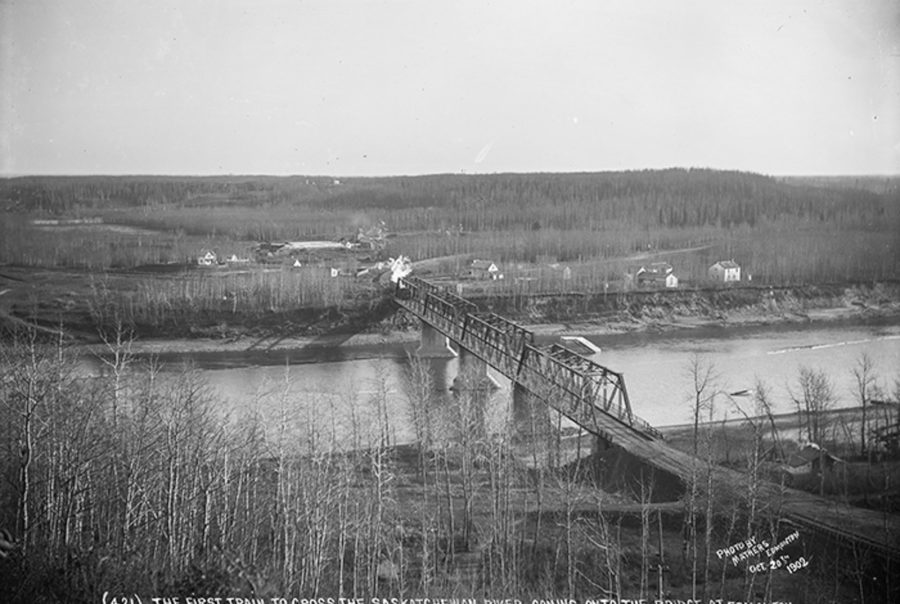
The first train to cross the North Saskatchewan River on the Low Level Bridge on October 20, 1902. The Low Level Bridge is the first bridge located upstream from the Tawatinâ Bridge. It was completed in 1900 and was the first bridge across the North Saskatchewan River. (Image courtesy of Provincial Archives of Alberta, B6212)
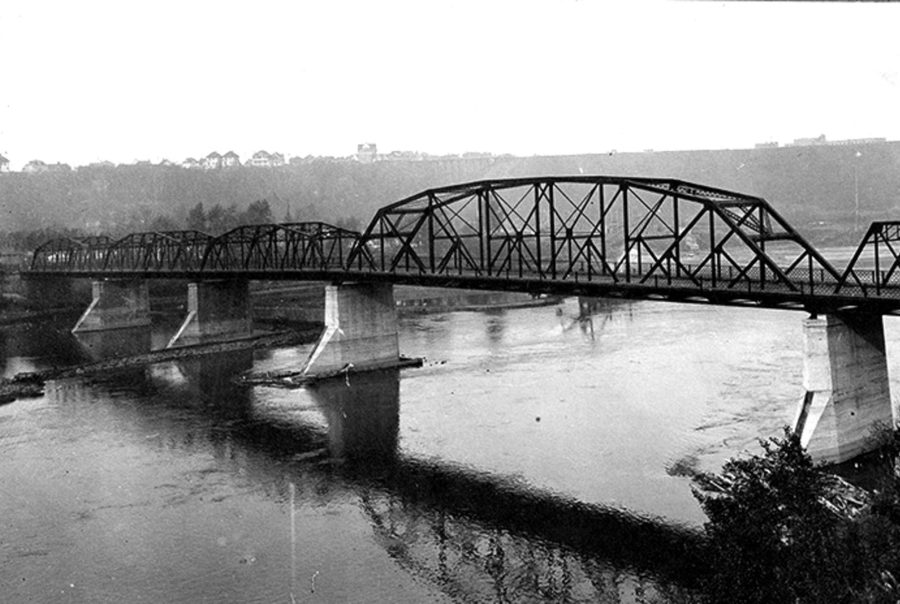
Marjorie St. Bridge, now known as Dawson Bridge, in 1913. The Dawson Bridge was opened in 1912 and is the first bridge located downstream from the Tawatinâ Bridge. (Image courtesy of City of Edmonton Archives, EA-500-337)
That is Danny Hoyt talking about how important it is to again have a bridge connecting Edmonton communities north and south of the North Saskatchewan River. After five years of construction, the Tawatinâ Bridge officially opened in December of 2021.
Tawatinâ means ‘Valley’ in Cree. The new 260-metre bridge connecting Cloverdale and Riverdale features two LRT tracks and a shared-use pathway below for pedestrians and cyclists to access river valley trails.
The ceiling of the bridge features artwork by Edmonton artist David Garneau. His Métis family settled in the area back in 1874. Garneau created the 400 panels with a team of assistants. The panels are a homage to the history, nature and First Nations and Métis presence in the region.
Danny Hoyt is a former president of the Riverdale Community League. He and his wife moved to Riverdale a year before the old bridge came down and really missed it when it was no longer there.
“The space itself provided a vantage point to view the city,” he remembers. “You’d see a lot of Edmontonians taking in the sight and chatting with each other in the evening. And we lost that when the bridge was gone.”
“And not only did we lose it,” Hoyt continues, “we lost it for an extended period of time. There were kids who started school in Riverdale and finished school without having experienced that particular sense of connection.”
But now that connection has been restored, and Hoyt says it’s clear he wasn’t the only one who missed it.
“When we had the reopening and community members from Riverdale and community members from Cloverdale walked across the bridge and merged in the middle, you knew that you weren’t the only one and it was just an immediate and clear, resounding reconnection,” Hoyt says.
“We had people yelling from the Riverdale side and the Cloverdale side all at once. You could tell you weren’t the only one who missed it and you weren’t the only one who felt good about that reconnection. It was really a beautiful moment. And ever since, we’ve been reconnected. You see people walking through Riverdale who are from Cloverdale and people walking through Cloverdale who are from Riverdale. You feel like you are part of Edmonton again.”
Hoyt is not only happy to again have that connection, but also with the kind of connection the new bridge is.
“I felt very glad that we ended up with the bridge we were promised. This bridge has these wide outlooks. It incorporates a wooden element and art. You feel grounded. You feel like the bridge is not just a crossing, it is a venue… You’re allowed to look and you’re allowed to just rest,” Hoyt says. “I’m very happy with the way it turned out. We would have loved for it to have been done earlier, but now that it’s here we’re just filled with gratitude for the fact that we are now connected to our neighbours and to some history and our Indigenous people.”
Sandy Fleming lives on the other side of the river, in Cloverdale. He agrees with Hoyt’s take: “It’s been really nice being able to walk across that new bridge. It’s been a long closure, but I think it’s been well worth the wait. It’s beautiful the way they designed it with the art installation… and the wide platform. I think it’s really inviting.”
Hoyt adds there may be another connection restored by the new bridge as well: for wildlife.
“We have in Riverdale a small deer population and a coyote population,” he explains. “We’ve always known they are there. We occasionally lose a cat, but for the most part we get along. When the bridge was out, we had a little bit of a problem because this crossing was gone and they could no longer access much of the river valley.”
The coyotes started nesting in Riverdalians’ yards and building dens. “We had litters under the doorsteps of some of our neighbours,” says Hoyt. “It raised the hairs on the backs of the necks of some people with young children. There were no major incidents, so we were ok.”
Now that the bridge is open, Hoyt says the community is seeing a little bit less of that animal behavior. The bridge provides more access for animals to be able to go back and forth and find places that are more accommodating. “So it provides a wildlife crossing as much as a human one,” Hoyt concludes.
Related Stories
Tawatinâ Bridge
“The Sorry Legacy of Métis Scrip”
Alberta’s Famous Five and Edmonton’s parks that bear their names
Bridges are connections. But some think that’s not always a good thing

Edmonton’s ribbon of green was not always so green

From bridge to table: The journey of wood from Cloverdale footbridge
